Thursday, 13 February 2020

A marathon without Garmin


A marathon without Garmin


It was just a few weeks ago, I had deactivated my social media accounts (Facebook/Instagram) to use the time more productively elsewhere. The goal was to remain gadget-free as much as possible, I know it's easier said than done, and I slowly started achieving the same, Fiddling with mobile phone reduced drastically. God granted my wish to go gadget-free to an extra level, I ended up running a  Marathon without Garmin (Initially not planned), and I thank God for this blessing in disguise. So here is the story and learnings of this experience of running a marathon without Garmin.


I had signed up for the Auroville marathon at the last moment, post canceling my plans to run the IDBI Delhi marathon, reason, as I had no intention to run a race for timing for now. I just want to enjoy my running and with no race or timing target pressures.

So at the start line of the Auroville Marathon around 4 Am, when I tried to switch on my Garmin watch, it gave a weird display that to save a workout of 90km, I remain puzzled for some time as that how did this happen! As the start timing was approaching fast, I didn't think much and tried to discard the workout of 90km, to my shock Garmin battery drained out, I tried everything to revive the watch without any success. It was not a situation that a runner wants to be in before a race. I had charged it to 100% before embarking on my journey from Bangalore, I without thinking too much went to the baggage counter and kept the watch inside my bag, as it's no point to wear a drained watch.

And I made a decision to run a marathon without a watch for the first time ever.

Just before the start, I saw Anuradha and the gang arrived for their Half marathon, which was supposed to start 1 hour after us at 6 AM. When I told her that my Garmin went bonkers, she offered me her new Garmin watch, which she was herself yet to wear in a race. I declined her offer gracefully, however, I was touched by her gesture. And I thought about her during the run.

I realized quickly there is no need to cry about something which is not in my hand and rather use this opportunity to get a whole new experience, and there is one race where I can actually try this was the Auroville, where you run for the joy for running, literally. So the race started at 5 am, I had decided to run this race by feel and take it easy. With no watch in my wrist, to be honest, it was like I was missing something in my body and it took my mind some time to understand, I brought my wrist in front of the face to check pace only to see an empty wrist, you see, how much a slave we become to it. My subconscious mind was not ready to accept it.

After 15-20 minutes into the race, I started listening to my breathing; I felt the rhythm in my legs, the motion of the arms. Overall, It leads to a refined sense of pace and effort. Racing is a skill that might take years to acquire with or without the watch, however, the more experienced you are, the less you rely on the watch. I started enjoying the race more than ever, this was my 4th Auroville Marathon. The first 1 hour we run in complete darkness, Auroville narrow trail with so many markings for turnings, one need to be extra careful in the narrow trail, many sections where only one person can run at a time., you can easily get lost or go in the wrong trail if you miss the markings. With all these things that need to take care you anyway don't have much attention left to check miles marker along the route.

With no watch strapped, I had no idea which Mile of the race I was into and what time was it. I started enjoying the trail. I met few debut marathoners in the trail, I met a young Doctor (25 years) who was running his first marathon there, obviously with no experience, he was running too fast, he ran with me for the first 1 hour or so, we had some good conversation, I warned him that he was going too fast, and he has another 30-32km probably left behind to run, he looked at his watch and said the pace is 5:30 mins/km, and this is what he has planned. Well obviously he was running much faster than what his Garmin was showing him, I could gauge with my effort that we were running probably just under sub 5 mins/km at that point of time. After he agreed to slow down and I went ahead.

We all know that Garmin constantly adjusts your pace to match the GPS’ “current” pace. A GPS watch can be a wonderful tool, it’s not perfect. If you think about it, this little tiny thing on your wrist is acquiring signals from outer space and using that to geolocate you.  with a lot of tree cover in the Auroville trail, satellites aren’t always going to be able to pick you up, which means the measurement won’t be as accurate. Hence that Doctor runner was seeing a pace much slower than what he was exactly running.

The above is a classic example of too much dependency on GPS watches can throw you off the pace and literally can screw your race by showing your wrong data. Relying exclusively on a GPS during training runs, a runner never develops the learned sense of pace that is critical to race day success. Even wearing a GPS device during a race doesn’t guarantee pacing success – what if the signal is lost, it happens in a city with a lot of tall buildings, Chicago Marathon is infamous for that, in trial running like Auroville with a lot of tree covers, to makeover the pace which we think is correct by GPS, we surge or runway faster, and when its actual time to push at the end we bonk, so it's very critical to know how to race and gauge the pace without GPS dependency.

We all have been in a situation during the run when you looked down in your Garmin and saw your pace, you get freaked out, as it is way slower than you were “supposed to be”, so we quickly start to push, and then when you see the next mile, you are now way too fast. Not only that, but you are now breathing much harder than you should be. so we slow down the pace, and then we spend the next entire mile pondering that what just went wrong.

So I reached the finish line, saw the big clock reading 3:32:xx!, to be very honest, I wasn't planning this run a sub 3:40. If I was running with Garmin. I would have purposefully done 3:50:xx

And after running the Auroville, to my surprise. I had no soreness or fatigue. Everyone at the finish line was telling me that I looked fresh and energetic post the run. I realized that the mental pressure of maintaining the pace throughout the run creates soreness and fatigue more than effort.


My two cents to all the runners don't be a slave to your Garmin. I am not telling you literally to give up wearing it. What I am telling is to IGNORE it until you finish the run. I know it's easier said than done, this is the one thing we struggle with the most.

Don't let your watch dictate your run, because by doing so you are not listening to your body. I again repeat I am not saying do not wear Garmin/GPS watch, I love mine and rarely go out running without it. But I rarely depend on them, instead, I listen to my body and rhythm, maybe due to this reason, I could pull a decent timing without much fuss in this Auroville.

So in this Auroville Marathon, I had no ideas of my splits, heart rate, cadence, pace, etc, rather I was overtaken by the joy of running, and this is what Auroville is known for to organize something purely for the joy of running. It considers all the finishers as winners and therefore does not award any prize money for the early finishers. Hence why it is not a timed run. And this is one of the biggest reasons why I look forward participating in this run each year. 


The wodden Auroville Medal and dusty shoe.

Thursday, 14 November 2019

The first mile is a liar!


The first mile is a liar - don't believe it for a second! 


I can relate to this because it can be interpreted both ways - A good start doesn’t mean a strong finish and vice versa. It’s typically a slow start for both physically and mentally, one needs to have for the first few miles running behind, rather than weaving around the crowd and suffering its consequences. 

Starting too fast too early may wreck your marathon by a good margin and way behind your target. , it can result in a DNF (Did not finish) as well. Going out too fast also makes you much more likely to hit the dreaded wall later in the race; high chances of hitting the wall go out too fast in the first 5k.

One of the most common pieces of advice for marathoners is don’t go out too fast! If you do you’ll suffer later. Some simply get caught up in the excitement of the start (I am guilty of that in the Berlin Marathon) and neglect to monitor the pacing before realizing the mistake. Whereas others plan to bank some time early on while they are still fresh. Yet others adopt a “go out hard and hang on for dear life” strategy. Well, the choice is yours.. :)


So in the Berlin Marathon, I did the above mistakes as I got carried away running my first World Major. Sharing the space with participants in total from 150 nations, thunderous crowd, carnival kind of atmosphere. I did get carried away and ran the initial 5-6 miles way faster than planned. 


46,983  participants in total from 150 nations


I would like to break up my marathon into phases to explain my mistakes and learn minutely. 


Here I am brimming with confidence just at the start!


The first 10k, was my fastest 10k for obvious reasons, weaving around the crowd in the initial mile, adrenaline rush! , locals just line up the entire 42.195km and root for you, The locals are the biggest fans of the race and the course is lined with spectators from beginning to end. They love to call out your name to cheer you on. I forgot the count, the number of times my name was called by someone from the crowd, "Come on Asif!" (They read your name on BIB) . Trust me each time my name was called out my speed shoot up 10 seconds faster, and these surges which were not necessary culminated in a disaster later...


The crowd, which I weaved around.


So the first 10k ended in 42 mins, which is faster by a margin of 4 mins (planned target). Well, 4-5 mins don't sound too much, isn't it? Let me break it up in this way. 

The first 10k should have been run in 47 mins, I ran in 42 mins. Means 5 mins faster than expected first 10k. If we break this 5 mins further it is 300 seconds, 47 mins 10k is 4:42 min/km pace, and 42 mins 10k is 4:12 min/km pace. So it means, I ran 30 seconds faster in each lap for the first 10k of a marathon distance. There you go! The disaster was waiting to happen in the latter part of the race. 30 seconds faster in each lap does make a huge difference, that too when I have another 32k left to run :)


By the time, I had realized my mistake during the course, I had already run the first half of the race in all the euphoria, amidst different bands all over the course & those cheerleaders with Pom-Pom :P 

The cheerleaders!

I ran the first 21k in 1:30:13, which should have been a 1:35:xx (planned one)
. Courtesy to my mistake in the first 10k, although I ran 2nd 10k marginally slower than the first one, the damage had been done. I made a mistake and the consequence was irreversible.


One of the bands along the route.

From 21k to 30k, I didn't feel any issue, I was firing on all cylinders, or maybe my body was giving indications, probably I did not understand or ignored. 

It’s around 30k onward when most runners hit rock bottom. There’s still a significant distance to cover, your batteries are running low. This phase really shows who has mentally prepared to run a marathon or rather finish it! 


The initial surges, weaving, and initial fast 10k, body ran out of fuel and went under too much stress. I suffered a bad pull in my hamstring around 34th Km, which caused a great rhythm to shatter and forced me to switch to plan B, to go slower and easier till the finish line, which I should have done in the initial miles. Although I got my PR in a world Major by more than 6 minutes. I ran Berlin with a time of 03:16:09. But I know I have missed a golden opportunity to get my desired time, had I didn't commit those mistakes. 


Just 100 m to go!


I will leave it for another day (Race). As they say, either we win or we learn from our mistakes.


There's nothing better than a finish line.

So here I am 15 official marathons down. Which is run across different geographies, in different courses, and some extreme weather conditions, I have learned not all but a few lessons, which I have shared below. 

What precautions we should take while running a marathon distance :


Our body is just like a car, the faster you run, the more fuel you burn. When you run at your marathon pace, you start to burn significantly more carbohydrates. 


Our body can store enough fuel to run about 2 hours at a marathon pace. This means unless we're running really fast, we'll need to take on a lot of extra carbohydrates during the run. 


Our body has a difficult time digesting the carbohydrates we take in while running (in the form of gels, bananas, etc). As our body becomes increasingly stressed, it begins to shut down non-essential functions such as the digestive system. So, while we could be consuming enough energy gels to keep our vitals alive, they may not be getting processed by our body. The best way to combat this unfortunate bodily function is to take on carbohydrates in fluids early in the race when our body is feeling good and not stressed.


Run the first 5-6 km a bit slower than marathon pace, it is important that we stay relaxed while running in the big crowds (especially world Majors) and weaving around runners. Relax and run with the flow until a natural opening for running appears, which usually comes within 5km, you need a hell of a lot of patience for this. I know that It is easier said than done. :P


Surging past slower runners and getting uncomfortable in the tight crowds is an easy way to ruin your race. All the surges and weaving in the initial phase require a lot of energy. (Energy = fuel) so the more energy and fuel you burn up during the first few KMs, the less you’ll have over the last 10k.


If you started the race a little slower, you’ll have a chance to absorb more of the nutrition you take on board.


The last 7-8k of a marathon is tough. and there is no way around it.


If you were conservative over the first few miles and taken adequate fluids and carbohydrates, you’re going to run well the last 10k. However, I suggest implementing some simple mental tricks.


  • To keep myself focus, I repeat these lines as mantras “I am fast, this feels good, I am strong, I’m running great." I talk to myself, It literally works for me.
  •  Keep your mind and body relaxed. Look within yourself and focus on yourself.
  • Good form – head straight, arms swinging forward and back slightly, powerful strides.


The finisher Medal. 

But it isn't the start that matters. It's the finish line.  It doesn't matter how well you start if you fail to finish."


Have Fun!

Monday, 4 November 2019

Never run alone!


Never run alone! 


When entering an 80 km race, you know you are going to be out there in the trail for a while. During that time, your mind will take you to places you have not explored before.

That is one of the reasons people take on such a challenge. Running becomes your spiritual guru.


One striking difference between the road races and ultras is that there is no shoulder-to-shoulder running for most parts of the ultra.


So here is something I have for you. For the Malnad ultra (80km category), I was by myself for probably all but the first 5k of the race. Runners went ahead, left behind right from the 5k mark when we entered the trails and after 1 km all disappeared into the thick jungle.


For the rest of the 12-13-hour race, I saw few souls again in that tropical forest and vast coffee gardens. Literally Just complete loneliness...


That is the moment when you get to be with your thoughts and internal chatter.


Our thoughts create our reality. When you feel good, you see the beauty of it all, the environment, the volunteers, the wilderness of nature.


And let me tell you that, this is the most difficult ultra I have ever run. Such extreme conditions, the never-ending elevations, Mud, slushy trail, leech bites & smashed legs. When you feel bad, you go to some really dark places in your mind.


During the course of the day, I had moments of immense gratitude and times of doubt. That is the pendulum of thoughts. However, I never felt alone.


Even though I was by myself, whenever I felt lonely or when negative, unhelpful thoughts occurred I had a trick up my sleeve.


'Dedicate Your Miles' was my strategy. It helps you to catch yourself going in a downward spiral of thoughts. What I did was whenever I felt troubled by my thoughts, I dedicated the section that I was on to a person that I have a connection.


There is of course, first and foremost my family. But you can extend it to family and friends, basically whoever you feel a connection with.


So even though I was by myself for the entirety of the race, I ran together with few guys Rajesh who was doing 110 KM category, met Sujith who was attempting his first 50 km + category, Sandeep and Rahul few others in a few sections, and segments.


Let me name the people to whom I dedicated the miles.


I ran with Prashant Hegde and Mahesh who were supposed to run New York Marathon this Sunday and their enthusiasm is contagious. And as I write this they are running this world Major!

I ran with Naghma, thinking of "All the miles I ran with her from past these many months over the weekend, which I love to do, I am sure she knows it ;)".
I ran with Movin, who is attempting a Half in Mumbai, trust me I had to convince him a lot for this :P
I ran with Sapna, who ran a great race in Bengaluru Marathon against all odds!
I ran with Jai Thomas who supports and encourages my passion for this beautiful sport called Running.
I ran with Smita, who ran a great Berlin race just a month ago and is a gem of a person.
I ran with Sushant and Arun. The Hegde trio including Prashant.
I ran with Subodh, who never ceases to inspire me.
I ran with Ravanan, who always stays positive and inspires others to do the same.
I ran with Nirupama, her never-give-up attitude inspires me always. 
I ran with Bhaskar, my childhood friend, Are we not like two volumes of one book?
I ran with Rajesh & Navaneeth who were running the 110 km category and I was rooting for them and honestly, they are the reason I didn't give up.  I ran with Shriram Bhai, Mark, Rajkumar, Shripad, Sandhya, Juri, Neelanjana, Gerald (my mentor and guru in running), Salim Bhai, Supriya, and many more.

Dedicating your miles made it feel like it was a celebratory reunion and an instant boost of morale away from negative chatter.


Reaching the finish line was a big achievement for me as it felt like I've started to get the hang of this ultra-thing. This was my 2nd 70+km run and although I know I can do better still, I feel that I am on the right track (or trail).


In the end, I conquered my physical pain over my mind and finished this grueling race of 80 km.


Here is the picture of the hard-earned Medal of 80 km category (It is a buckle)


Trail lonely trail. 


After finishing the race 


The trails
Small lake somewhere amidst the forest

Ridges 

Trail across the coffee estates

Wednesday, 30 October 2019

Tata Mumbai Marathon 2018


Tata Mumbai Marathon 2018


TMM 2018, after a good season of training behind me, I started the race with confidence. Everything was going well according to the plan, not only a PR, but a number better than my target was in sight. But they said, a marathon isn't finished until you actually finish it!

 At 37th Km, the last climb of Peddar Road, when you just have to run the last 5km to reach home. Everything seemed to fall apart all of sudden, I got a bad hamstring pull in the downhill of Peddar road. The Pull was such that I stood still for a moment, held my hamstring which got stiff, eventually I fell on the road, got up to fall again. I was literally banging my head on the road, a target which was achievable a moment ago, was slipping away from my eyes. I was lying helplessly on the road, holding my hamstrings. Then Mumbaikars came to my rescue, I was given immediate attention,  massage, stretching on my hamstring, salt pills, coke, and water, were offered immediately. It helped me to recover quickly from a show-stopper. I remember 3 gentlemen and one lady gave me support to stand, in that process I lost 7 precious minutes at 37th km. I began slowly walking again with a fear of another pull. People started cheering me, you feel like a hero, even though you didn't finish the battle, as if the finish line is in sight, 'come on Asif just 5k push' like encouraging words from crowd. It gave me much needed confidence to start slowly and gradually and I finished the last 5km at average 5:20 pace and completed the race,  got a PR by 2 minutes, finished the race in 3:22:45..

Surely Marathon is an Unknown Beast! 

I dedicate this run to the people of Mumbai. And this is the reason why I come to Mumbai to run each year (my 4th year in a row ). Without their support and motivation, I would have turned another  DNF story, coming so close to the finish line.


It's truly said by Kathrine Switzer"If you are losing faith in human nature, go out and watch a marathon".


A finish line Picture with Bobby and Prasad. All happy faces.. :)


Tuesday, 19 September 2017

MY TRYST WITH KHARDUNGLA CHALLENGE 2017


MY TRYST WITH KHARDUNGLA CHALLENGE 2017

I am Asif Ahmed and I am a runner. I have run 11 marathons so far and the Khardung La Challenge 2017 (72 km race) was my debut run as an ultra-marathon runner. My marathon PB is 3:24 hours (SCMM 2016). So far, I have never felt the need to document my running experiences. For the first time ever, I pen my story about this incredible journey that helped me understand myself better and changed me as a person. I write this for the future runners attempting this Challenge and for myself to revisit my experience since the faintest ink is stronger than the strongest memory. 

So here is my Khardung La story.


One of the moments during the Khardungla run.


Ever since I heard about the Khardung La Challenge ultra-marathon in Leh way back in 2013, it has fascinated me. Being born and brought up in the hilly landscapes of picturesque Shillong, climbing hills and running on trails while enjoying nature came easily to me. Thus, the Khardung La Challenge allured me.

I finally decided to participate in the ‘Khardung La 2017 edition’ in September 2016. I had one year to prepare myself, mentally and physically. Indeed, the mental aspect is very important in ultra-running and even more so in Khardung La Challenge. Mental preparation is the decisive factor between being a finisher or ending up as DNF (Did not finish).


This journey was not easy, be it the training or discussing it with fellow runners to gain valuable insights. I have runner friends like Dharmendra Kumar (himself a Khardung La finisher 5 times!) who has always inspired me to take up the challenge. On the other hand, I still remember this guy (who had cycled in Khardung La in the past) mocking me when he heard of my intention to run this ultra-marathon race. I was even asked whether I know what is a mountain? Although he unsettled my confidence briefly, this incident made me even more determined about my goal and focused me to reach the finish line of this race. I guess I should be thankful to him as well for that.

I started training right after my Standard Chartered Mumbai Marathon in January 2017, I ran two more marathons as practice runs (the Auroville Marathon and The Run Of Raramuri Tribe Marathon) without aiming for any timing. I also ran a couple of good long runs of (35k +) during my training.


The most significant practice run for me occurred on June 17, 2017, in Bengaluru, a 100 kilometer run from HSR to Hosur and back organized by Mr. Sushil Bhasin. I achieved my objective, with the help of fellow runners, of running the entire 100 km distance. I completed this over 15 hours. My sole intention was to be on my feet for more than fourteen hours and to remain injury-free while clocking high mileage training. The final cut-off timing in Khardung La Challenge is 14 hours, with 3 phases of cut-off timings during the race.

Acclimatization of altitude is imperative and important while training for the Khardung La Challenge. Without a proper acclimatization process, all the rigorous training at sea level will fall apart easily. While running at 5359 meters of altitude above sea level, with oxygen levels 50% lower compared to sea level, and a low air pressure environment, runners are susceptible to high altitude sickness. The more mountain runners understand about symptoms of acute mountain sickness (AMS) during training the better. AMS symptoms are breathlessness, headache, dizziness, nausea, and vomiting.

I didn’t take this knowledge flippantly. For better acclimatization, I traveled from Delhi to Manali and from Manali to Leh by road on purpose. During the journey, not only did I acclimatize better, but I also met many wonderful people, who inspired me further for my tryst. I stayed two days at Manali (2050 m) and ran there both days in trails, before embarking on my 36-hour journey to Leh. The landscapes were breathtaking. Manali Leh highway has 5 passes.
Rohtang - 13,050 ft.
Baralacha La- 16,500 ft.
Nakee La - 15,647 ft.
Lachunglang La- 16,663 ft.
Tanglang La- 17582 ft.


Running in the trails of Manali. 


Before beginning the journey on the highway towards Leh, it is advisable to stay at the starting point Manali, at least for one night and again one night at either Keylong or Jispa to cope with high altitude passes. Not taking these precautions during the ascent causes acute mountain sickness and even death! Owing to the rarefied atmosphere (low air pressure) at high altitude, less oxygen is breathed in and many travelers experience AMS. The Himachal Pradesh Tourism Development Corporation bus conductor who knew this highway told us some horror stories along the way.

During the bus journey, we stopped for a lunch break just before 'Baralacha La pass'. I met two backpackers Sachin Chhachhia from Mumbai and Monja Wolf from Germany, they were sitting inside a makeshift tent for a lunch break. I found that they were walking daily in extremely harsh conditions from Nubra to Manali, which is approximately 600 km distance! They were very excited to know I am going to attempt Khardung La Challenge. Monja said that she was inspired to meet a “Khardung La Challenge Participant” since she had kept looking at the ultra-marathon poster in Leh and had wondered how this challenge would feel. They gifted me a book ‘The diary of a young girl - Anne Frank’. I was very happy, I felt enriched after meeting them and I hugged them. After they left, I pondered about them walking in this cold desert in such harsh conditions, where there is no civilization for hundreds of miles. Such superhuman effort. This was one of the many inspirations, I experienced during my journey towards my own Khardung La Challenge.

With Sunil and Monja


The journey took a toll on my body and I was welcomed to Leh by my first symptom of acute mountain sickness. I felt a throbbing headache and nausea. My brother, who serves in the Indian Army and posted in Leh, hosted me during my first day there. The main reason I went to my brothers house was my craving for some home-cooked food and care. The next day I shifted to a guest house which I shared with runners Pawan and Gaurav, who were running the Ladakh marathon and half marathon respectively.


On September 6th, following two days of rest in Leh after some walking around town and climbing the Shanti Stupa, I decided to run a short 7 km run. My reality check happened on that very run. My heart was beating unusually faster and my lungs were crying for oxygen at this altitude of 11480 feet. I felt fatigued. Lack of oxygen made my body sore. I introspected that on the race day, I will be running at an average altitude of 14000 feet and climbing the highest motorable pass in the world. I glanced at Khardung La pass, which was clearly visible from my guest house. I got more and more jittery and anxious. I avoided eye contact with the pass. I ran another 5 km the next day and decided to rest for another two days before the race day. The more you respect the mountains, the easier they make way for you.


The 104 ultra participants were taken to Khardong village by bus before the race day, as per plan. Khardong village, which is 72 km from Leh and 14738 feet above sea level, is the start line of the Khardung La Challenge. The evening was spent enjoying the local Ladkahi cultural program and interacting with runners from different countries. 

The first practice run in Leh. 


In Bus, en route start line (Khardong village)

The night before the actual race four random runners were assigned a village house, where we would stay for a night. We were asked to follow an elderly person who took us to his house. We were complete strangers when I met other runners, the only thing which was common was that we were doing Khardung La Challenge the next morning at 3 am. One of the guys in my group was wearing an uncommon cap, his name is Mr. Praveen Teotia. On the cap was inscribed MARCOS. MARCOS is the Indian Navy’s Marine Commandos. I asked him if he was truly a commando and he answered in the affirmative. He was indeed an ex-MARCOS commando. I have no words to express my excitement about meeting a MARCOS commando in person. I was curious to know more about him. I prepared a questionnaire in my mind for asking this respectable soldier of my country.

This ex-commando told me that he was one of the commandos who participated in the military operations during the 26/11 Mumbai terror attack. I was shocked to know that he had only one lung, the other lung was punctured by a bullet shot during the anti-terrorist operation. I saluted him with deep respect. He had interesting stories to tell us about the operation and his life as a MARCOS commando. I felt fortunate to have met him. What I was attempting the next morning seemed minuscule compared to his accomplishments and selfless sacrifice for the nation. He inspired me and instilled a never-give-up attitude.


From Right - Praveen Teotia, Sish Pundir, and Satyajit.


THE RACE DAY -:

“Running has taught me to redefine success and failure because it is not about the outcome, it's not about the time, it’s not about the personal record - it's not even about making it to the finish line. It is about having the courage to show up.” - Kelly Roberts

The above lines best explain my feeling whilst standing at the start line at 3 am, 14378 feet above sea level, in a freezing minus 3 degrees. The multiple layers put on from head to toe did little to help from the cold. The participants hugged and wished each other at the start line. The race was flagged off at 3:00 AM. For the first time in my life, I was confused about whether to run, jog or walk at the start itself! It was a moonlit night and I was running towards a sunrise so I did not carry my headlamp.

The temperature variation from the Khardong village to the finish line at Leh was from -8 to +28 degrees celsius. The race starts at an altitude of 14378 feet, up to North Pullu which is at 16000 feet, then to the Khardung La Top at 18380 feet (5602 meters) above sea level, and then down to South Pullu (15300 feet) and finishes at Leh (11483 feet). The qualifying cut-off time till the Khardung La top is 8 hours (the total cut-off time for Khardung La Challenge being 14 hrs).

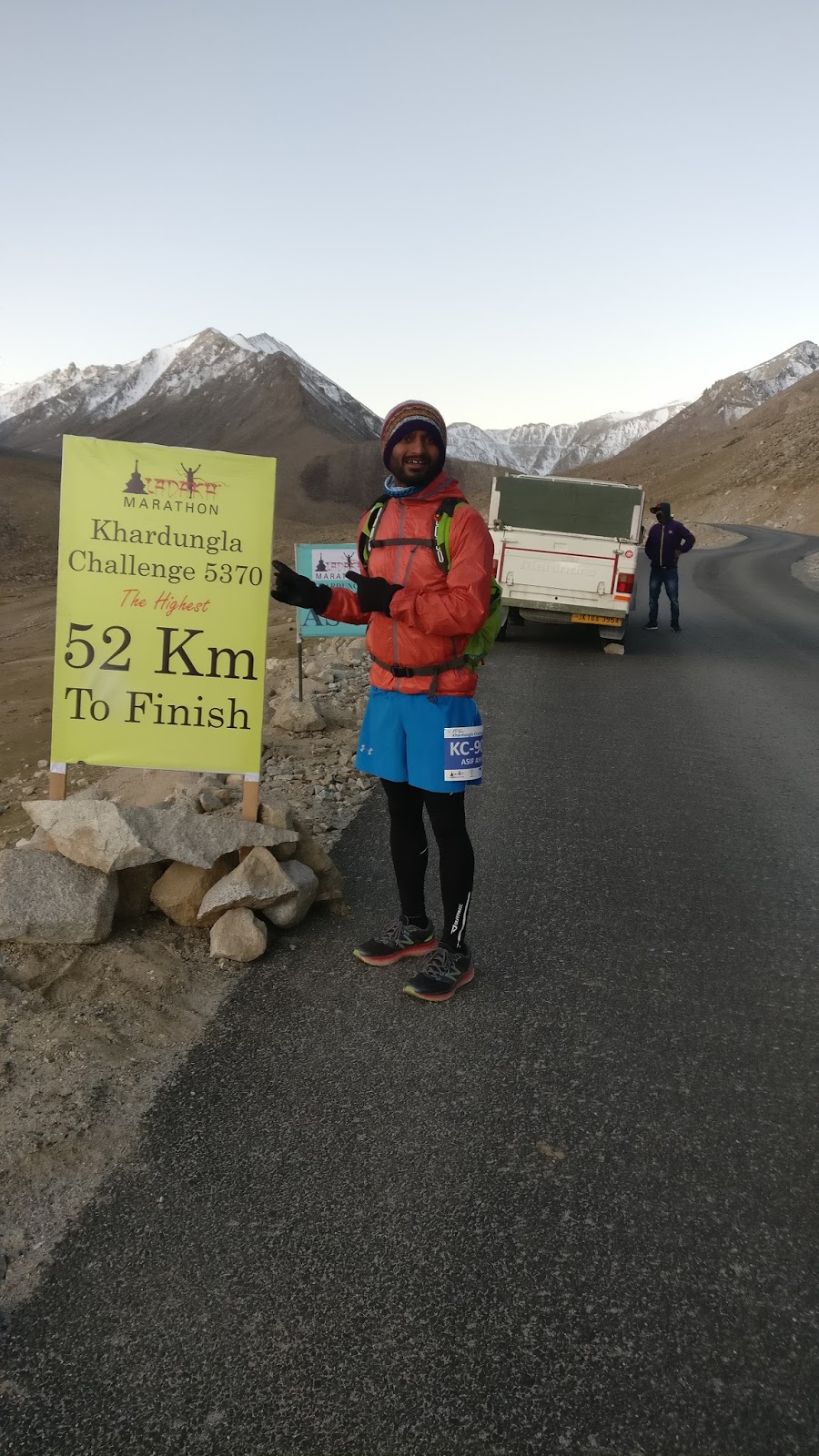
I started running at a very slow pace and met many runners and we introduced ourselves. Gradually I began feeling confident. The initial 18 km until North Pullu is a smooth, well-tarred road. From 18 km until 32 km at Khardungla La top, running is not easy, in fact, it is life-threatening. Maximum DNF (did not finish) happens in between North Pullu to Khardung La top, due to very low temperature, low air pressure, and bad roads full of ice sheets in patches. It is important to run wisely and negotiate the challenging conditions carefully.


After North Pullu (During the race)


After crossing the North Pullu, at 16000 feet, the roads rendered were actually un-runnable. The temperature dropped further drastically. I continued walking fast and slowly overtook many runners in this patch.

During the race, I took about ten pee breaks since I was hydrating a lot, which is key to survival at a high altitude. Around 20th km, as I took a pee break, a large piece of stone came crashing down the mountain and fell about 8 feet away from me. I looked up and feared for my life. I actually stopped peeing halfway somehow and started running again, since then I became paranoid and was frequently looking up. It is a landslide-prone area. A day before the race, it had snowed a lot and loose rocks from mountains are vulnerable to fall with high chances of landslides.

At the 28th km, just four kilometers before Khardung La top, I saw a runner lying on his face on an icy patch of road. Someone recognised him as the recent Uttarkashi ultra winner. He was badly affected by altitude sickness. I supported him and walked about 100 meters with him, I gave him water and some dates. Soon an ambulance arrived and he was boarded there, thus I witnessed the first DNF.  


When I was running up the Khardung La top which is at an altitude of 5,359 meters, the temperature was freezing minus 8 degrees. The high-altitude air pressure conditions and low levels of oxygen in the atmosphere make running distances even more arduous. Just two kilometers before the peak, I began swaying like a drunkard, due to low oxygen supply to the brain (mountain sickness). The altitude just shuts the brain. I lost self-control. I crossed the pass and immediately sat beside a rock for twenty minutes to calm myself down. This was the real test of my nerves and the actual Khardung La Challenge had just begun. Thoughts of giving up the race flooded my mind.

The moment when I reached Khardung La top.


At Khardungla Top (5359 m)


With Army Jawans who motivated me in Khardungla top

I burst into tears and became emotional multiple times during this race. I felt puny amidst the huge mountains and vast expanse of Mother nature. A tiny soul struggling for survival. The race just rips the mind and body apart and this made me feel vulnerable, that is when you realise how vain city life is.


As I sat on a rock helpless at Khardung La top, some army jawans came and encouraged me.  They informed me that I was amongst the first few non-Ladakhi runners to have reached the top. Meanwhile, a volunteer gave me some hot garlic soup. This worked like a magic potion and it gave me the much-required warmth. A volunteer then suggested I peel off some layers here as the temperature would rise while running downhill. I did the needful. I remember meeting a British runner named Christopher. He started talking about sprinting to the finish line and running downhill and started babbling something. He seemed to be under the effect of AMS already or perhaps my mind couldn’t grasp it since I was myself struggling.

Running downhill has never been as difficult as I experienced that day. My mind said ‘It is all downhill now, I can run but my legs just wanted to give up. The reason is the fatigue which sets in after a 32 km climb to the Khardung La top at low oxygen levels, squeezes out maximum energy from the body. My decision to apply the strategy of ‘run two kilometers and walk for a small distance’ worked well till the 60th km. Running downhill for 40 km, on my own, with nobody in the vicinity was daunting.


During the descent from Khardungla Top

During the descent from Khardungla Top

During the descent from Khardungla Top
During my last 12 kms, I gradually started pushing myself without many breaks. At the 67th kilometer mark,  with only 5 km to finish, I saw a bunch of volunteer cyclists. They were waiting to guide us through the town of Leh to the finishing point. The possibility of getting lost and running in the wrong direction is high in the last five kilometers. Hence a cyclist pacer is allocated as navigator to each runner until the finish line.
During downhill run before reaching Leh city. 


My cyclist navigator was a young guy named Rigzin, I handed him my hydration pack, and he started pacing me. I asked him to cycle ahead of me so that I could push myself a little. The last 5 kms of the race is in the town of Leh which is dotted with guest houses and hotels. People came out in overwhelming numbers to cheer us, they knew the effort we had put to reach there, and the sound of clapping and cheering still resonates in my ears.

In the last 5 kms, I did not feel alone at all. I became all emotional and tears started rolling. I had never felt such respect and crowd support in my lifetime. I had only seen it in the Ultra Trial Mont Blanc races telecasts. Meanwhile, my cycling navigator informed me that only 1.5 km was remaining to the finish line.

I saw a local Ladakhi runner just ahead of me. Now all I wanted to do was to overtake him in order to gain the additional sense of pride that I actually overtook a seasoned Ladakhi runner in this epic race in Ladakh. Finishing the race was important but overtaking him before the finish line seemed even more important at that time. As I pushed myself harder, my cycling navigator began to cheer me loudly and with the thunderous crowd encouragement, I overtook this Ladakhi runner just 500 meters before the finish line at Leh Bazar.

During the finishing of the race.

I began crying upon finishing. I had got a new lease of life and felt some fresh energy seep into me. I was running at a good pace just before, I reached the finish line. I deflated like a balloon and sat down. A guy came and wrapped a white shawl around my neck. I was taken to the medical camp for a routine health check-up. My oxygen levels and blood pressure were low. I started to cough, I realised I am in a bad shape. I looked around me and saw that the runners who had finished ahead of me were in a similar state. I heaved a sigh of relief. Such is the nature of this beast called the Khardung La Challenge. The doctor asked me to rest inside the medical tent for an hour until my vitals normalized. I felt better after an hour of rest but remained feverish the whole day, due to sheer exhaustion. Later the Ladakhi runner whom I overtook came to congratulate and hug me in the medical tent. I was visited by Gaurav who was my roommate in Leh. I met my friends from Shillong, Badon Tham, and Sai Singh, who congratulated me and took some memorable pictures. I was tearful and happy. I had little energy to go back alone to the guest house.


Right after finish

I crashed and sat, right after finish.. 
At the finish line.

At the medical tent. Clicked by Gaurav, who later shared this pic.

After recovering at the Medical tent.

The following day all Khardung La finishers were felicitated, with government officials as chief guests at the medal distribution ceremony.

The medal was given to each individual on stage.


It doesn't require any caption :)

I couldn’t have asked for more in my maiden Khardung La attempt. I did not run Khardung La, Khardung La let me run that day. I will never dust off what Khardung La and the mountains gave me, it is an experience of a lifetime and I will carry it with me forever.

I would like to thank my parents, friends, and well-wishers. Special thanks to Sapna Agarwal, who always supported me during my training and kept me in her prayers, Smita Deshpande, who was rooting for me throughout my race, Prashant Hegde, Shripad Kamat, and Keshav, for your special gesture, and to Dharmendra  Kumar for always believing and inspiring me.


I am now officially a finisher of the highest Ultra-marathon in the world and my timing was 10 hours 32 minutes 20 seconds
The results page.

An overview of my race in the mountains can be seen in this link.
The much-coveted medal.


Post-race lunch with fellow participants. 


In the memory of dad

  Dad left us exactly a year ago. Today, last year, I put him to the final resting place in a graveyard not far from my house with a heavy h...